Navigating the Hidden Risks in AGV-AMR System Sourcing
We often hear people with AGV-AMR users (not Savant users) say “We’re having a hard time getting parts and technical service for the system we bought from [SUPPLIER NAME], and we’ve only had this system for__ years (typically 5-8)!! It’s costing us way too much time and money to keep this system running. That’s why we either need to replace it or shut it down.”
How did these customers end up in that costly situation? Many times, their pre-purchase fatal mistake was that they did not pay enough attention evaluating their favored system supplier’s true AGV-AMR business profile, i.e. the source of its technology and equipment and the impact that would have to its ability provide the customer with long-term support.
To help customers make the best-informed supplier choices, we would like to share a new resource we have put together, “SA Insights 260620 – SYSTEM SUPPLIER TYPES,” which details a critical but often overlooked risk in our industry: the AGV-AMR system sourcing framework
When investing in Automated Guided Vehicles (AGVs) or Autonomous Mobile Robots (AMRs), organizations often operate under the assumption that their supplier is the original manufacturer. In reality, many suppliers are dealers, integrators, or licensed OEMs who source their underlying core navigation and system controls from third parties.
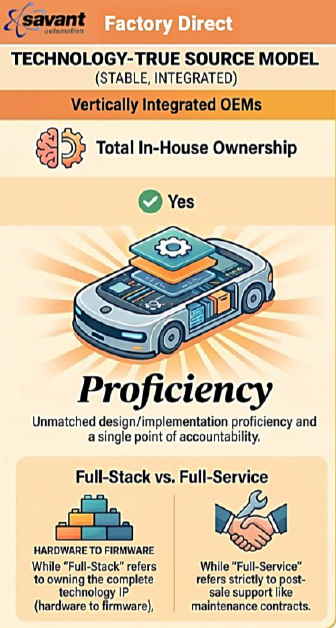
On the other hand, Savant is a True, Vertically Integrated OEM…….it’s our in-house developed technology (navigation, control system, software), our manufactured vehicles and our project execution and our aftermarket parts and service support. We don’t license from third parties and that’s why we have many customers with systems running over 20 or 30 years. Savant deals with obsolescence issues because it is our technology no matter how old it is.
It’s the difference between dealing with a ‘middleman’ or ‘direct with the factory’.
We have outlined how these distinct supplier profiles heavily impact your operational execution, customization options, and long-term asset lifecycle support over a 20+ year horizon. Understanding this framework is essential for eliminating the vendor “finger-pointing” trap during critical support windows and protecting your infrastructure investment from third-party parts and software obsolescence.
I have attached the full document to this email for your review.
Additionally, we have published a summary discussion on LinkedIn. I encourage you to view it, join the conversation, and share your experiences regarding multi-vendor support and single-point accountability in automated systems. You can find the post and engage with our industry network here: https://www.linkedin.com/feed/update/urn:li:activity:7474833352655519744
Please take a few moments to review the attached insights, and feel free to reach out directly if you would like to discuss how these supplier dynamics apply to your current or upcoming automation initiatives.